
The Chesapeake Ecology Center (CEC) promotes community greening/sustainable living practices through a variety of educational initiatives and through various media. We also promote and provide assistance for conservation landscaping/habitat restoration projects at the CEC and elsewhere.
Self-Guided Garden Tours…Mindfulness Walks…
Weekends @ Mary Moss @ J. Albert Adams Academy/CEC
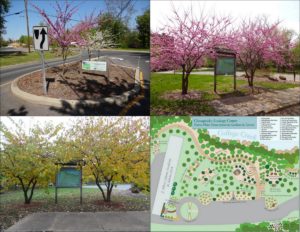
Examples of some of our conservation landscaping initiatives—including 24 Native Plant Demonstration Gardens and Groves—can be seen on the campus of Mary Moss @ J. Albert Adams Academy, 245 Clay Street, Annapolis, MD 21401. Since the MM@JAAA/CEC Gardens and Groves are located at a middle school, plus 9th grade, visiting hours during the school year are after 5 p.m., and anytime on the weekends and during the summer. Please note that dog walking is prohibited on the school grounds. Directions . Download CEC brochure.

Weekends are a great time to enjoy a self-guided Tour of the Gardens and Groves. Reconnect with nature and yourself on a Mindfulness Walk through the grounds—the perfect antidote to our tech-filled lives. Being in nature encourages mindfulness and brings us into the present more easily than other activities. It helps us quiet the constant chatter and distraction of our stress-filled, over-scheduled lives.
“Come forth into the light of things. Let nature be your teacher.” –William Wordsworth
RainScaping Park and RainScaping Education Stations

Installed in the fall of 2015—with adjustments made in 2016—the latest of numerous Highland Beach environmental projects is the installation of the Highland Beach RainScaping Park. View the web album—Fall 2015 and Spring 2016, Installation of the RainScaping Park. (Project design and installation management provided by the CEC.)
View the RainScaping Education Station at Quiet Waters Park page, and the web album—Fall 2011, Installation of the RainScaping Education Station and Rain Garden. (Project design and installation management provided by the CEC.) Since the installation in 2011, environmental groups have followed our lead by using the RainScaping Education Station plans and signage for their projects to help educate homeowners and communities about “Beautiful Solutions to Water Pollution!“
Highlights of Habitat Restoration Projects,
Garden Tours, and Special Events
 * View the web album—EVOLUTION OF THE DNR RAIN GARDENS, FROM 1998 TO APRIL 2012. At the forefront of rain garden installation, two Tawes Parking Lot Rain Gardens at the Maryland Department of Natural Resources (DNR) were originally installed in 1998. After becoming overgrown with invasive weeds, the rain gardens received a major overhaul in the spring of 2012. Along with the landscape architect, the CEC provided project management for the 2012 overhaul of the rain gardens.
* To see highlights from our first decade, 2002-2012, click here.
* View the 5-minute video RainScaping at the Chesapeake Ecology Center, produced by Maryland Public Television.
* The CEC and Master Gardeners have been inducted into the 2014 Volunteer Project Hall of Fame, for the Master Gardener Shade Garden Installation! Learn how Master Gardeners Make a Huge Impact at the CEC.
